
Planning Permission in a National Park
VESP Architects are pleased to announce the recent granting of Planning Permission for an extension and renovation to a heritage property in the Dartmoor National Park, achieved in collaboration with Atticus Planning. The proposal received unanimous local support and was approved under delegated powers.
The scheme seeks to sensitively modernise and extend a historic dwelling located within the heart of Dartmoor National Park, a designated National Landscape. The elevated site is defined by its dramatic rocky hillsides and mature specimen trees, forming a striking natural setting.
The host dwelling is a former fisherman’s cottage, dating in part to 1885, which has been extended and altered multiple times over the last century. A series of poorly configured additions and a convoluted internal layout had resulted in a weakened relationship between the principal living spaces and the surrounding landscape.
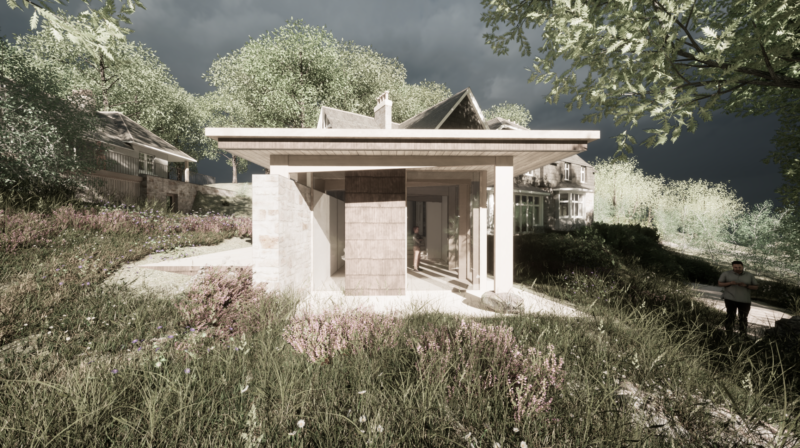
Extending a heritage property
Our client, a professional classical musician, approached us with a brief to create an inspiring performance and rehearsal space, capable of accommodating teaching and small community concerts. The proposals replace an incongruous 1990s conservatory with a carefully repositioned extension and a heritage-appropriate, hand-crafted bay window. These interventions restore clarity to the historic elevations of the house.
The new extension has been deliberately conceived in contrast to the ordered and angular evolution of the original dwelling. This approach establishes a clear architectural dialogue between old and new, acknowledging the site’s layered history rather than attempting pastiche.
Within the context of the host building, the extension is intentionally recessive, achieved through:
-
Stepping the new accommodation down to improve its relationship with the surrounding landscape
-
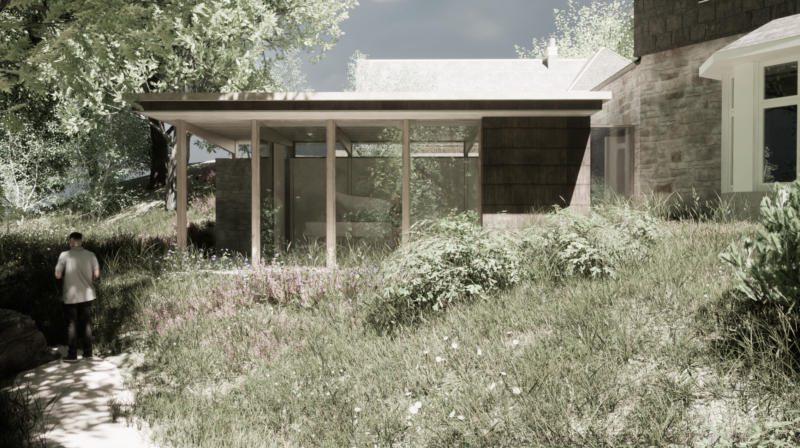
Introducing a generous glazed link to clearly separate the contemporary intervention from the historic fabric
-
Employing a flat pavilion roof to create a low-profile, low-impact addition
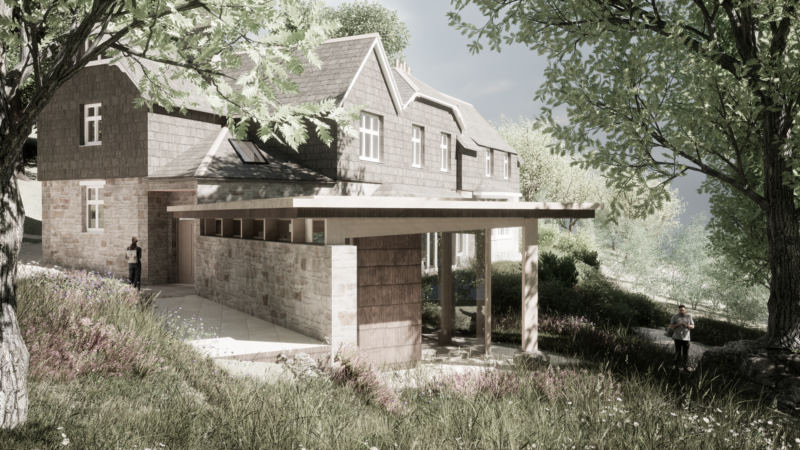
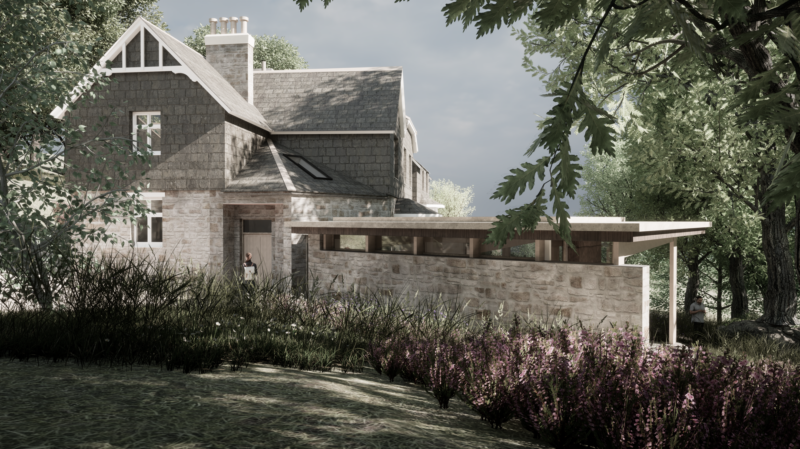
The extension will be formed around an expressed oak glulam frame, with articulated junctions and a staggered hit-and-miss ceiling rake to introduce rhythm and visual interest. A strong arterial stone wall will be constructed using reclaimed stone sourced on-site and from a nearby granite quarry, with a sharp clerestory glazing element above. A refined, handmade clay tile will complete the composition, used selectively across two purposeful roof panels.
Upgrading the performance of historic properties
In parallel, the client sought to significantly improve the thermal performance of the existing dwelling. In collaboration with GoGreen Engineering, a range of discreet energy-efficiency measures have been incorporated, including heritage-appropriate vacuum-sealed glazing, internal and external wood fibre insulation, and breathable limecrete slab construction. These measures ensure both the long-term protection of the heritage asset and a comfortable, efficient internal environment.
We look forward to the project progressing on site in 2026 and will be sharing further updates as the works commence.
If you would like to discuss your own project, please contact us here